Showing posts with label US Dollars. Show all posts
Monday, August 6, 2018
Bitcoin and Gold -- A Hyptothetical Perspective

Bitcoin and Gold -- A Hypothetical Perspective
Ok, let's really take the time to think about this. Over the last few years, both Bitcoin and Gold have gained more ground as stores of value. As of 2017, Bitcoin value got as high as 20,000 times the value of the dollar--while gold hovered around $1,300 or so an ounce.
,
If both are stores of value and both are considered to be worth investing in-- wouldn't you expect the price of Gold to skyrocket to be worth at least $5,000 an ounce?
With news of many institutions and corporations looking to make Bitcoin ETF a reality-- we could see Bitcoin reach $32,000 USD in value--and with that rise, I believe gold could shoot well past $2,500 an ounce.
Do you see a correlation in Bitcoin and Gold ascension?
Tuesday, October 21, 2014
Fed Emergency - Fabricated Recovery Is Stalling
Africa
,
bank of england
,
bearish economy
,
buy gold
,
buy silver
,
China
,
dollar
,
dollar bills
,
falling stocks
,
finance
,
financial
,
gold buyer
,
Gold futures
,
US Dollars
No comments
:
Guys, THIS IS BIG.
Take Care. (Of You & Your $$$)
TheDollarDecline
In this video Mike Maloney tries explaining why and how the US Government is creating a false sense of economic security to the nation. If you work hard for your money and you want it to matter, I suggest you watch this. If you have further questions about how you can protect yourself against the pending wealth transfer, visit my site here.
Take Care. (Of You & Your $$$)
TheDollarDecline
Wednesday, October 15, 2014

Wednesday, October 1, 2014
3 Reasons To Invest In Gold (Video)
bank of england
,
Brazil
,
China
,
finance
,
Germany
,
India Gold Buying
,
LBMA
,
moneywatch
,
QE1
,
QE2
,
QE3
,
Ukraine
,
United Kingdom
,
United states
,
US Dollars
,
Vietnam
No comments
:
"The World Considers Gold as Money, and China actually promotes it as money and has cornered the market."
"Gold will be responsible for the biggest wealth transfer (from West to East) in ALL OF HUMAN HISTORY."-Alasdair Macleod
"The three biggest reasons to invest in gold" In this 2nd of a series of London interviews that Lars Schall conducted for Matterhorn Asset Management this summer, Lars has a City street conversation with Alasdair Macleod. Together they talked about, inter alia: the challenges for the LBMA; China's appetite for gold; the Shanghai Cooperation Organization as the player in the gold market in the future; and the problems related to Germany's gold at the New York Fed. Alasdair Macleod started his career as a stockbroker in 1970 on the London Stock Exchange, and learned through experience about things as diverse as mining shares and general economics. Within nine years Macleod had risen to become a senior partner at his firm. He subsequently held positions at director level in investment management, fund management and banking. For most of his 40 years in the finance industry, Macleod has been de-mystifying macro-economic events for his investing clients. The accumulation of this experience has convinced him that unsound monetary policies are the most destructive weapons that governments can use against the people. Accordingly, his mission is to educate and inform the public, in layman’s terms, what governments do with money and how to protect themselves from the consequences.
Tuesday, September 23, 2014
Economic Recovery On The Horizon? 3 Stats To Watch
bearish economy
,
employment
,
home building
,
home buying
,
housing market
,
manufacturing
,
recession
,
unemployment rate
,
US Dollars
No comments
:

Article from: CNN MONEY
There is so much data on the economy now, it is hard to figure out what is most important. Last week alone exemplified the flood of numbers: the Census Bureau, Federal Reserve and Labor Department released a variety of economic data points.
The big news makers -- employment, inflation and gross domestic product -- are always important statistics, but if you really want to know where things are headed, there are a few lesser known indicators that give a fuller picture of the economy's health.
To make some sense of it all, CNNMoney surveyed numerous economists. According to the experts, keep an eye on these three things.
1. People's spending: Shoppers have a big impact on the economy. Consumption makes up over two-thirds of the America's gross domestic product. The Great Recession made people a lot more cautious about buying things. And when people aren't buying, that also hurts company profits and jobs.
"You can't sustain strong economic growth without the consumer leading the way," said Sal Guatieri, senior economist at BMO Capital Markets in Toronto.
The question is whether buying is back.
The best way to gauge that is the monthly Personal Consumption Expenditures (PCE) index.
At the height of the recession in 2009, PCE decreased, and it still is not back to its pre-recession levels.
What most economists -- and businesses -- want to see is steadily increasing spending. But so far in 2014, there have been three months where PCE has dropped, including July. That's worse than 2013 where the PCE increased (or at least remained level) every month.
Bottom line: Not back yet
2. Home buying and building: The housing collapse was at the center of the recession. The slow recovery of the housing market serves as a microcosm of the economy's tepid comeback.
"Home ownership has historically been the single largest trigger to consumer spending," said Diane Swonk, chief economist at Mesirow Financial in Chicago.
People who buy homes tend to buy more of other products than non-buyers, which suggests that home buying can trigger a positive ripple effect on personal spending and jobs, Swonk says.
Economists are watching a data point known as "housing starts."
Single-family housing starts in July numbered 656,000, or about 10% higher than the same time last year, according to the Census Bureau. Still, the number of these housing starts is 50% below a typical level, says Robert Denk, senior economist at the National Association of Home Builders in Washington D.C.
A more normal level of housing starts would be about 1.3 million, the average between 2000 and 2003, Denk says.
"The recovery truly can't be considered complete until housing gets back on track," Denk says. "[Housing] generates jobs and it still really is that sector of the economy that hasn't fully recovered, in fact it's only halfway back."
Bottom line: Not back yet
3. Manufacturing: America might be known for Silicon Valley more than steel these days, but the country still makes a lot of products.
Another indicator that holds implications for the greater economy is the PMI, an acronym for the wonky-sounding Purchasing Managers' Index (that term was actually abandoned in 2001). Created by the Institute for Supply Management, the PMI gauges manufacturing levels across the country, taking several factors into consideration, including employment and inventory levels.
In a positive sign for the recovery, the PMI hit a 12-month high in August at 59%, according to ISM. The average PMI at the recession's peak in 2009 was 46.4%. Thus far in 2014, the PMI has averaged 54.9%, signaling a healthy gain in manufacturing during the recovery.
There are some concerns that the really strong U.S. dollar could hurt manufacturing, since it makes American goods a lot more expensive to people in Europe and other parts of the world, but so far there doesn't seem to be an impact.

Monday, September 22, 2014
Oklahoma Affirms Gold and Silver as Legal Tender
bearish economy
,
benjis
,
buying gold online
,
dollar
,
falling stocks
,
gold
,
gold coins
,
gold heist
,
India Gold Buying
,
QE1
,
QE2
,
QE3
,
Reuters
,
United states
,
US Dollars
No comments
:

On June 4, Oklahoma joined Utah, Texas, and Louisiana in affirming that gold and silver coins are (as they always have been under the Constitution) legal tender in the payment of debts in the state. On the surface this seems almost nonsensical: affirming a right that already exists in Article I, Section 10 of the U.S. Constitution. But it is much more than that.
Senate Bill 862, which Oklahoma Governor Mary Fallin signed into law this week, says,
Gold and silver coins issued by the United States government are legal tender in the State of Oklahoma.No person may compel another person to tender or accept gold or silver coins that are issued by the United States government, except as agreed upon by contract.
The new law also exempts all state-level taxes that Oklahoma residents would otherwise have to pay when exchanging gold or silver back into paper money:
For taxable years beginning on or after January 1, 2015, there shall be exempt from Oklahoma taxable income, or in the case of an individual, the Oklahoma adjusted gross income, any amount of net capital gains ... which result from the sale or exchange of gold or silver for another form of legal tender.
All this appears to do is affirm the language from the U.S. Constitution: "No state shall ... make any Thing but gold and silver Coin a Tender in Payment of Debts."
But it does much more. Sean Fieler, Chairman of American Principles in Action, one of the bill’s primary supporters and promoters, came close to explaining why:
I commend the people of Oklahoma, particularly Senator Clarke Jolley and Governor Mary Fallin, for asserting their state’s constitutional right to declare gold and silver legal tender.
With the Federal Reserve actively suppressing interest rates and eroding the purchasing power of the U.S. dollar, it is welcome news to see one more state give its citizens free access to money that holds its value over time.
It’s about options. When citizens become comfortable with using money that retains its value over time, it will mark the beginning of the end of paper currency backed by nothing. This would be the inevitable end point of the process that began on August 15, 1971 when then-President Richard Nixon unilaterally ended the dollar’s convertibility into gold. For the past 43 years the world has been subjected to floating currencies pegged to nothing other than future promises to pay in more paper money. As Ron Paul noted in his book The Case for Gold, first published in 1982,
Under a gold standard, the amount of credit that an economy can support is determined by the economy’s tangible assets, since every credit instrument is ultimately a claim on some tangible asset. But [today’s] government bonds are not backed by tangible wealth [but] only by the government’s promise to pay out of future tax revenues....
In the absence of a gold standard, there is no way to protect savings from confiscation through inflation....
This is the shabby secret of the welfare states’ tirades against gold. [Unlimited] deficit spending is simply a scheme for the hidden confiscation of wealth. Gold stands in the way of this insidious process.
Paul was referring to the "shabby secret" revealed by former Federal Reserve Chairman Alan Greenspan before he was assimilated by the monetary Borg of the Federal Reserve. In July of 1966, Greenspan wrote in Gold and Monetary Freedom about that secret:
In the absence of a gold standard there is no way to protect savings from confiscation through inflation. There is no safe store of value....
If everyone decided, for example, to convert all his [paper] bank deposits to silver [or gold] ... bank deposits would lose their purchasing power and government-created bank credit would be worthless....
This is the shabby secret of the welfare statists’ tirades against gold. Deficit spending is simply a scheme for the “hidden” confiscation of wealth. Gold stands in the way of this insidious process....
If one grasps this, one has no difficulty in understanding the statists’ antagonism toward the gold standard.
That confiscation has been accelerating exponentially since 1971, as seen by clicking here to view price levels in the United States from 1965 through 2013. Once the gold standard was abandoned by Nixon in 1971, the price level in the United States has risen by a factor of six! Put another way, citizens’ paper money has lost almost 80 percent of its value in just 43 years.
That Oklahoma has joined with other states in its affirmation of gold and silver (with still others considering similar measures) could mark the beginning of the end of the paper machine itself — the Federal Reserve. William H. Greene is an economics professor at New York University’s Stern School of Business. While a seemingly unlikely spokesman for the abolition of the Fed, his view of the coming inevitable end of the Fed is remarkable:
Over time, as residents of the state use both Federal Reserve Notes and silver and gold coins, the fact that the coins hold their value more than Federal Reserve Notes do will lead to a “reverse Gresham’s Law” effect, where good money (gold and silver coins) will drive out bad money (Federal Reserve Notes). As this happens, a cascade of events can begin to occur, including ... an influx of banking business from outside the state ... and an eventual outcry against the use of Federal Reserve Notes for any transactions. [Emphasis added.]
This is most encouraging to the Tenth Amendment Center, which noted, "Once things get to that point, Federal Reserve notes would become largely unwanted and irrelevant for ordinary people. Nullifying the Fed on a state-by-state level is what will get us there."
That’s what makes Oklahoma’s affirmation of a right so important. If every state would affirm their rights under Article I, Section 10, the end of the Fed would merely be a matter of time. Federal Reserve Notes would become irrelevant — a relic of a failed statist experiment in organized, sophisticated theft.
Friday, September 19, 2014
Funny Money
art
,
benjis
,
buying gold online
,
death of the dollar
,
dollar bills
,
drawings
,
financial future
,
five dollar bills
,
funny
,
humor
,
money
,
sketches
,
ten dollar bills
,
US Dollars
No comments
:
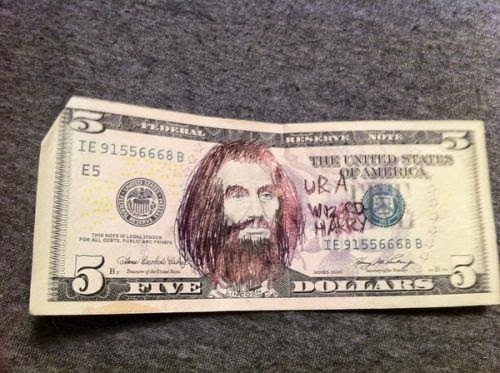
#HappyFriday guys. Thought that these currency sketches could bring some humor into all that's going on in today's economy. Check these out and enjoy.
 |
| KI$$. |
 |
| George...On The Run? |
 |
| Five Dollar Bill Murray. |
 |
| Lincoln Without The Hat |
 |
| PATRICK! |
 |
| Captain Washington. |
 |
| It's'A Meee! |
 |
| I'm...BATMAN. |
 |
| This is either Ozzy or Mona Lisa with shades...eh. |
 |
| Einstein! |
 |
| The captions on the bills say it all. |
 |
| LOL. Excellent. |
 |
| G-Dub In King Of Diamonds (Miami) |
 |
| A Bathing Lincoln. |
 |
| The Euros Power Readings Are Off The Charts! |
 |
| Really? |
 |
| What Does Marcellis Wallace Look Like? |
 |
| Abe LINKoln. |
 |
| Don Juan Benjamin. |
 |
| Daredevil |
 |
| Krusty Washington |
 |
| Episode 10. Attack of the FIAT Currency. |
 |
| The Official Currency Of Congress |
 |
| Abe The Bounty Hunter |
 |
| This Benji Is Brought To You By Corporate America. |
-TDD
Subscribe to:
Posts
(
Atom
)